
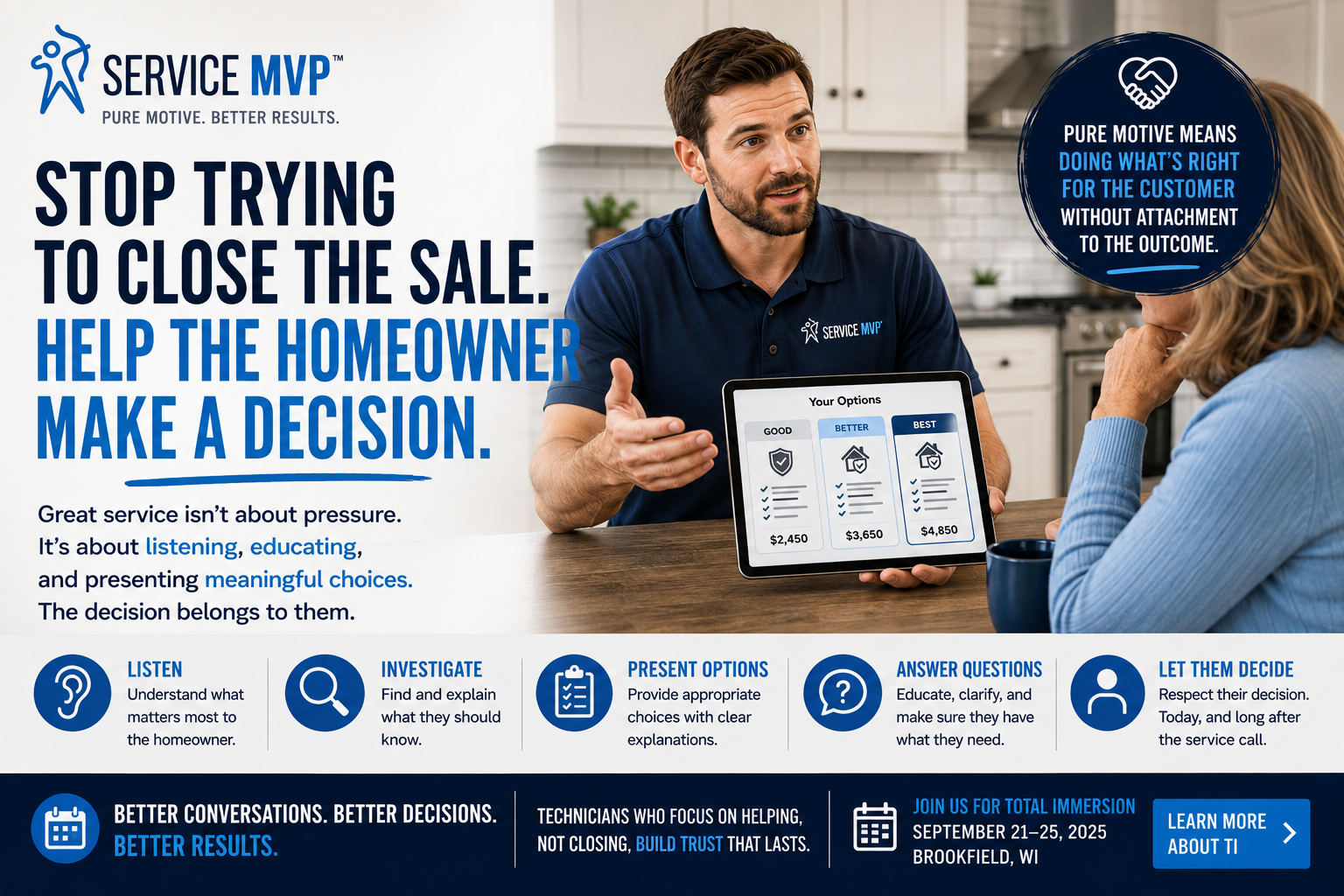
Stop Trying to Close the Sale: Help the Homeowner Make a Decision
Stop Trying to Close the Sale: Help the Homeowner Make a Decision
By Joe Crisara, Author of What Should We Do? and Co-Founder of Service MVP
For years, sales training has taught people to focus on one thing:
Close the sale.
Ask for the business.
Overcome the objection.
Create urgency.
Get the signature.
And in some industries, that may be exactly what salespeople are hired to do.
But there's a problem when we bring that same mindset into a homeowner's kitchen.
Your service technician wasn't invited into the home because the homeowner wanted to be sold something.
They were invited because someone needed help.
That's why I want home service professionals thinking differently.
Your job isn't to get the homeowner to say yes. Your job is to help the homeowner make a good decision.
That may sound like a small distinction.
It changes almost everything about the conversation.
The Homeowner Isn't a Sale to Be Closed
Think about what happens when a technician's primary goal is getting the sale.
Every question can start becoming a sales technique.
Every observation becomes an opportunity to increase the ticket.
Every objection becomes something that needs to be overcome.
Every option becomes part of a closing strategy.
And the homeowner can feel it.
Most homeowners have spent their entire lives being sold to.
They know what pressure feels like.
They know when someone is steering them toward a particular answer.
And they know when the person sitting across from them seems more interested in the transaction than the problem they called about.
That's not the experience we're trying to create.
At Service MVP, we teach something we call Pure Motive.
The idea is simple:
Do what's right for the customer without attachment to the outcome.
What Does Pure Motive Actually Mean?
Pure Motive doesn't mean ignoring sales.
It doesn't mean technicians shouldn't identify opportunities.
And it doesn't mean we shouldn't run profitable home service businesses.
A business that doesn't make a profit eventually loses the ability to serve anyone.
Pure Motive is about why we're doing what we're doing.
If I ask a homeowner a question because I'm trying to manipulate them toward an expensive option, that's one motive.
If I ask the same question because I'm genuinely trying to understand what matters to them, that's another.
The words could be identical.
The motive changes the conversation.
The goal isn't:
How do I get this person to buy?
It's:
How do I make sure this person understands what I found and has enough information and appropriate choices to make a good decision?
That's a service professional.
Start With Curiosity, Not a Pitch
The best home service conversations often begin with questions.
Not because questions are a clever sales technique.
Because we actually don't know enough yet.
The homeowner may have called because the air conditioner stopped cooling.
But what has the experience been like leading up to the breakdown?
Has this happened before?
Are certain rooms uncomfortable?
Are utility bills concerning them?
How long do they plan to live in the home?
Has reliability become a frustration?
Are there other issues they've simply learned to live with?
What matters most to them about solving the problem?
Until we understand those things, how can we possibly know which solution makes the most sense?
Diagnosis isn't only about equipment.
We need to understand the homeowner's priorities too.
Investigate Before You Recommend
Once we understand why the homeowner called and what matters to them, we can investigate the system properly.
This is where technical expertise and communication expertise meet.
A great technician isn't looking around the home thinking:
“What else can I sell?”
They're thinking:
“What else should this homeowner know?”
That's a very different question.
Maybe they discover something related to safety.
Efficiency.
Reliability.
Water quality.
Indoor air quality.
Electrical protection.
Preventive maintenance.
A worn component.
A recurring issue.
Or something that has nothing to do with the original reason for the call but legitimately deserves the homeowner's attention.
If it's real and relevant, we should communicate it.
Then the homeowner can decide whether it matters to them.
Identifying an Opportunity Isn't the Same as Selling Something
This distinction is incredibly important.
Some technicians resist identifying additional opportunities because they don't want to feel like salespeople.
I understand that.
But imagine noticing a legitimate problem and deliberately not telling the homeowner because you're afraid they'll think you're selling.
Is that really better service?
If you see it, explain it.
If it matters, educate them.
If there are appropriate solutions, create choices.
Then let them decide.
You don't need to pressure someone simply because you showed them an opportunity.
Information isn't pressure.
What we do with the information determines whether the experience feels helpful or manipulative.
Give Homeowners Meaningful Choices
Once we've listened, investigated, and communicated what we've found, we can create appropriate solutions.
That's why I'm such a believer in options.
One problem with presenting a single solution is that we accidentally make the decision about us.
“Here's what I think you should buy.”
Now the homeowner's choices are basically:
Accept my recommendation or reject it.
Instead, we can say:
“Based on what we found and what you told me was important, here are several ways we can approach this.”
Perhaps one option addresses the immediate problem.
Another provides additional protection.
Another solves several related concerns.
Maybe one prioritizes economy while another prioritizes longevity, convenience, efficiency, or peace of mind.
There isn't necessarily one universally correct answer.
There's the solution that best fits this homeowner.
We've explored this idea further in Stop Giving Homeowners One Price: Why Service Technicians Should Present Options.
Don't Secretly Decide Which Option They Should Pick
This is where Pure Motive gets tested.
We build six options.
Then we look at the homeowner and think:
They'll never buy that one.
So we barely explain it.
Or maybe we really want them to choose the premium solution, so we spend most of our time selling that one.
Either way, we're starting to take control of a decision that doesn't belong to us.
Present the appropriate choices.
Explain the differences.
Answer their questions.
Then let go of the outcome.
The homeowner might choose the most comprehensive option.
Great.
They might choose the most economical option.
Great.
They might choose nothing today.
That's their decision.
Our responsibility is the quality of the process, not controlling the answer.
“What Would You Do?”
Eventually, a homeowner may ask:
“Okay, but what would you do if this were your house?”
Technicians hear this all the time.
And it's tempting to pick an option for them.
But there's a problem.
It's not your house.
Your priorities may be completely different.
Your finances may be different.
Your tolerance for risk may be different.
Your plans for the home may be different.
Instead of making the decision for them, bring the conversation back to what they've already told you.
If reliability was their biggest concern, remind them which options provide the strongest protection.
If budget was the priority, show them which choices address the immediate need economically.
If they plan to stay in the house for 20 years, longevity may matter more.
The homeowner has probably already given you clues about what matters.
Help them use their own priorities to make the decision.
What Happens When They Say No?
This is another place where a closing mindset and a service mindset can look very different.
The homeowner says:
“I think we're going to hold off.”
If our goal is closing the sale, our brain immediately searches for another technique.
What objection haven't I overcome?
How can I create urgency?
What can I say to get them across the line?
But sometimes the correct response is simply to understand.
There may be a concern we haven't addressed.
So ask.
Listen.
Make sure they have the information they need.
But if they understand everything and still choose not to move forward?
Respect the decision.
Pure Motive doesn't disappear because the homeowner said no.
In our previous article about the homeowner saying “That's too expensive,” we made the same point: the goal isn't to overcome the homeowner.
It's to understand them.
A “No” Today Doesn't Mean the Service Call Failed
This is especially important for owners and managers.
If we judge technicians only by whether they closed the call, we shouldn't be surprised when they start behaving like closers.
Instead, look at the quality of the process.
Did the technician listen?
Did they investigate thoroughly?
Did they identify legitimate opportunities?
Did they explain what they found?
Did they connect solutions to homeowner priorities?
Did they create meaningful choices?
Did they present those choices confidently?
Did they respect the homeowner's decision?
Those behaviors create something bigger than one ticket:
Trust.
And trust creates relationships.
A homeowner who doesn't choose a solution today may call you six months from now.
They may buy a maintenance membership.
They may choose you when replacement time comes.
They may refer their neighbor.
They may leave a five-star review because, for once, they didn't feel pressured by a contractor.
Don't sacrifice a potentially 10-year customer relationship trying to force a decision today.
Here's the Interesting Part: This Can Also Be Better for Business
Some contractors hear Pure Motive and assume we're saying:
“Don't worry about revenue.”
That's not what I'm saying at all.
I believe home service businesses should be profitable.
Technicians should identify legitimate opportunities.
Homeowners should see multiple appropriate solutions.
Companies should understand their profitable hourly rate.
Pricebooks should protect margins.
Memberships and recurring relationships matter.
But there is no contradiction between serving the homeowner properly and running a profitable company.
In fact, the two should support each other.
When technicians ask better questions, they often discover more legitimate needs.
When they investigate thoroughly, they uncover more opportunities.
When they communicate clearly, homeowners better understand the value.
When they provide choices, customers have more ways to say yes to something that fits.
And when homeowners don't feel pressured, trust grows.
The result can absolutely be more revenue.
But there's a huge difference:
Revenue becomes the result of a better service process—not the motive driving it.
Your Technicians Can Feel the Difference Too
There's another benefit we don't talk about enough.
Many technicians hate “sales training.”
Why?
Because they got into the trade to fix things.
They don't want to manipulate people.
They don't want to become slick closers.
And they don't want to walk into someone's home feeling like they have a sales quota hanging over their heads.
So don't train them to become salespeople.
Train them to become exceptional service professionals.
Teach them to be curious.
Teach them to listen.
Teach them to investigate.
Teach them to communicate.
Teach them to build choices.
Teach them to confidently explain those choices.
Teach them how to respond when the homeowner becomes uncomfortable.
And teach them that the homeowner's decision belongs to the homeowner.
Now we're not asking technicians to become something they're not.
We're helping them become better at the job they already chose.
Stop Trying to Close. Start Trying to Help.
If there's one idea I want your team to remember, it's this:
You don't need to control the homeowner's decision to have a successful service call.
Understand the problem.
Understand the person.
Investigate thoroughly.
Communicate honestly.
Create meaningful choices.
Answer questions.
And help them decide.
Sometimes the answer will be yes.
Sometimes it will be no.
Sometimes it will be:
“Let me think about it.”
That's okay.
Because when your motive is right, your process is right, and your technicians have the communication skills to execute it, you don't have to chase the close.
You can focus on delivering an exceptional service experience.
And very often, the business results follow.
Pure Motive Has to Be Practiced
Understanding this philosophy is relatively easy.
Using it when a homeowner challenges your price, rejects an option, asks what you would do, or tells you they're getting three other estimates is harder.
That's why we practice these conversations.
Our next Service MVP Total Immersion takes place September 21–25 in Brookfield, Wisconsin, hosted at Quality Heating, Cooling, Plumbing & Electrical.
Over five days, technicians don't just hear communication concepts. They have the opportunity to practice the conversations, receive coaching and feedback, make adjustments, and try again.
Because Pure Motive shouldn't just be something your technicians understand.
It should be something your customers experience.
