
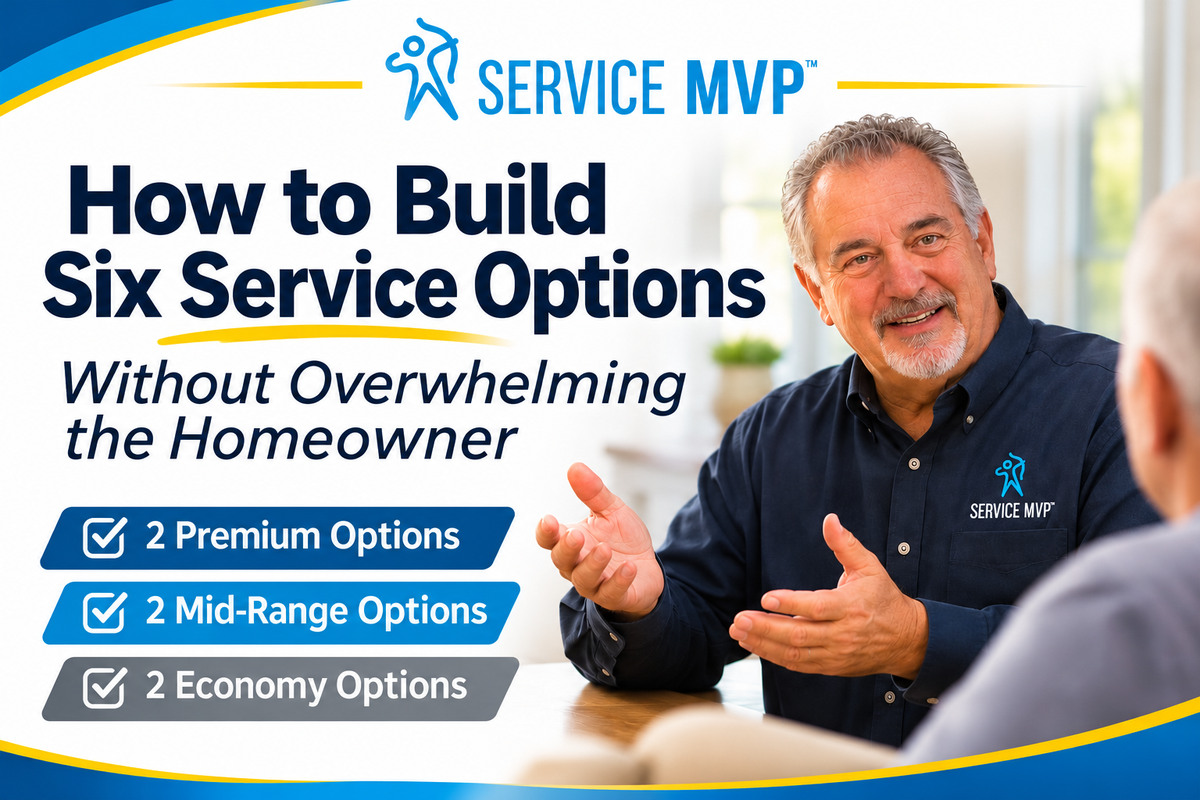
How to Build Six Service Options Without Overwhelming the Homeowner
How to Build Six Service Options Without Overwhelming the Homeowner
By Joe Crisara, America's Service Sales Coach and Author of What Should We Do?
Are six options too many for a homeowner?
It's one of the questions I hear from HVAC, plumbing, and electrical contractors when we introduce our six-option service presentation process.
And I understand the concern.
A technician spends time diagnosing a problem, discovers several conditions that deserve attention, and now has to explain six different ways to address them.
Won't the homeowner get confused?
Won't they just choose the cheapest one?
Wouldn't it be easier to give them one price and let them decide?
Here's what I want you to understand:
The problem isn't necessarily the number of options. It's how those options are built, organized, and communicated.
Six poorly constructed options can absolutely overwhelm a homeowner.
But six thoughtfully designed options can make a complicated decision much easier to understand.
Let's talk about how.
Why Giving One Price Can Actually Make the Decision Harder
Imagine a homeowner calls because their air conditioner isn't cooling properly.
The technician diagnoses the immediate failure and says:
"It's going to be $875 to repair it. Would you like us to do that?"
Now the homeowner has one decision:
Yes or no.
But what if the technician also discovered that the system has airflow restrictions, neglected maintenance, and other conditions affecting comfort or reliability?
What if the homeowner plans to stay in the house for another 15 years?
What if they're more concerned about avoiding another breakdown than minimizing today's expense?
A single repair price doesn't necessarily address those priorities.
It assumes the technician already knows which solution the homeowner wants.
And that's a dangerous assumption.
At Service MVP, we teach technicians to diagnose thoroughly, communicate what they've discovered, and give homeowners meaningful choices.
The goal isn't to sell six things.
The goal is to help the homeowner choose one solution that fits their needs.
The Structure: Two Premium, Two Mid-Range, and Two Economy Options
One reason six choices can feel manageable is that they aren't presented as six unrelated proposals.
They're organized into three understandable levels.
| Level | Number of options | General purpose |
| Premium | 2 | More comprehensive solutions that may address broader system concerns, comfort, reliability, and longer-term needs |
| Mid-range | 2 | Solutions that address the immediate problem along with selected additional improvements |
| Economy | 2 | More limited solutions focused on the immediate problem, with differences in scope, service, or warranty |
This structure comes directly from our Pure Motive Service option-building training.
Think about how people make other purchasing decisions.
They may already know whether they're looking for a basic solution, a middle-of-the-road solution, or something more comprehensive.
When you organize the choices into those categories, the homeowner doesn't have to compare six completely different ideas at once.
They can first consider which level fits their priorities.
Then they can compare the two choices within that level.
Six options become three understandable categories, each containing two choices.
That is much easier to communicate.
Step 1: Start With the Problem the Homeowner Called About
This is one of the most important rules in building service options.
Every option should address the original reason the homeowner called, provided the proposed work is appropriate and can be performed safely and to code.
If they called because the furnace isn't heating, every option needs a legitimate path to resolving that problem.
If they called because the kitchen sink is leaking, don't build an elaborate plumbing proposal that forgets the leak.
If they called because an electrical circuit keeps tripping, the options need to address the diagnosed cause of that concern.
Why does this matter?
Because the homeowner needs to recognize their problem in the solution.
When technicians begin with unrelated upgrades or improvements, customers can feel as though the original reason for the visit has been forgotten.
And once that happens, trust becomes harder to maintain.
The immediate problem is the foundation.
Additional improvements should build on that foundation—not replace it.
Step 2: Diagnose the Whole System Before Building Options
You cannot create meaningful choices if you haven't identified the conditions that might affect them.
For an HVAC technician, that could mean examining relevant airflow, electrical, control, installation, and maintenance conditions.
For a plumber, it might involve checking the associated piping, pressure, drainage, installation, or equipment condition.
For an electrician, it could mean evaluating the affected circuit and related safety or installation concerns.
This doesn't mean inventing problems.
It means identifying and documenting legitimate findings.
At Service MVP, we teach technicians to organize their observations around the customer's original concern and other relevant factors, including safety, health, design, installation, age, and neglect.
That gives the homeowner a clear picture of what was discovered.
It also gives the technician the information needed to build options that genuinely differ in scope and value.
Better options begin with a better diagnosis—not a better sales pitch.
Step 3: Build the Options From Economy to Premium
Although we teach technicians to lead the presentation with the premium option, it can be helpful to understand the construction process from the bottom up.
Start with the most limited appropriate solution.
What work is necessary to address the immediate issue?
Then consider a second economy choice.
Could that solution offer a meaningful improvement in scope, service, or warranty?
Next, develop the two mid-range options.
What additional diagnosed conditions could reasonably be addressed?
Could the homeowner benefit from improved reliability, related system corrections, or a more comprehensive service arrangement?
Finally, build the premium choices.
What would a more complete solution look like for this homeowner?
Would a broader renovation, replacement, system enhancement, or longer-term service arrangement be appropriate?
The top option should be especially thoughtful.
It should reflect what the homeowner told you matters to them.
Not every homeowner wants the same thing.
One family may care most about comfort.
Another may be focused on long-term reliability.
Someone else may be concerned about safety, future maintenance, or avoiding disruption.
Your premium option should reflect the customer's priorities—not a generic list of expensive add-ons.
Step 4: Make Every Option Meaningfully Different
Here's where technicians sometimes struggle.
They create six prices.
But they don't create six distinct solutions.
The homeowner sees several proposals with similar descriptions and different totals.
Naturally, they ask:
"What's the difference?"
If the technician can't answer that clearly, the options aren't ready to present.
Every choice should have an understandable reason for existing.
Differences might include:
- The amount of diagnosed work being addressed.
- Repair versus broader system improvement, where appropriate.
- Reliability or comfort enhancements.
- Planned maintenance or ongoing service.
- Warranty coverage.
- The extent of the system being restored or renovated.
The differences must be real, clearly described, and supported by the diagnosis.
Don't add unnecessary work just to create another price point.
And don't use confusing technical descriptions to make one option sound more impressive.
A homeowner should be able to understand what changes between the options and why that difference matters.
Step 5: Use Homeowner Language, Not Technician Language
You may understand static pressure, voltage drop, combustion temperature, or pressure-reducing valves.
Your homeowner may not.
And that's perfectly fine.
They didn't call you because they wanted to become an HVAC technician, plumber, or electrician.
They called because they wanted help.
Consider the difference between these explanations.
Technical explanation:
"Your return duct is undersized, resulting in elevated static pressure and reduced airflow."
Homeowner-focused explanation:
"The system isn't getting enough air back through the ductwork. That can make it harder to keep the house comfortable and can put additional strain on the equipment."
The second explanation connects the condition to something the homeowner can understand.
It's not about eliminating technical accuracy.
It's about making the information useful.
When you're building six options, that clarity becomes even more important.
Use straightforward descriptions.
Explain the purpose of the work.
Connect it to the customer's concerns.
And make sure the written option sheet supports what you're saying.
Step 6: Personalize the Premium Option
In our training, we teach technicians to use the homeowner's name and a meaningful word or priority when naming the top option.
Why?
Because the best solution should feel connected to the actual customer—not copied from the last service call.
Suppose a homeowner tells you:
"I'm just tired of worrying about this system breaking down every summer."
If the diagnosis supports a comprehensive solution, a title such as:
The Johnson Family's Worry-Free Comfort Solution
...may communicate the purpose more effectively than:
Option A - Premium Package
The title alone doesn't create value.
The work still needs to be appropriate, and the benefits must be explained accurately.
But personalization can help the homeowner understand that you listened.
And being heard matters.
Step 7: Present the Premium Solution First - Without Pressure
At Service MVP, we teach a premium-first presentation.
That doesn't mean insisting the homeowner purchase the most expensive option.
It means beginning with the most comprehensive solution and explaining what it addresses.
Why start there?
Because it establishes the full range of possibilities.
The homeowner can see what a complete solution might involve before comparing more limited alternatives.
Then the technician can explain how the other choices differ.
For example:
"This first option addresses the original problem, the related conditions we found, and the longer-term concerns you mentioned. The next option addresses many of those same issues, but with a more limited scope."
From there, continue explaining the meaningful differences.
The goal is to make the options understandable.
Not to create urgency.
Not to frighten the homeowner.
And not to make them feel embarrassed about their budget.
Pure Motive Service means helping people make an informed decision that works for them.
Step 8: Don't Confuse Providing Choices With Pushing for a Sale
There's an important difference between saying:
"Which one would you like?"
and saying:
"You need to buy one of these."
Our training emphasizes moving away from a single yes-or-no price presentation and toward meaningful choices.
But the homeowner still has every right to ask questions, request time, decline the work, or seek another opinion.
A good technician respects that.
If the customer looks overwhelmed, don't rush them.
Ask:
"Would it help if I explained the main differences between these three levels?"
Or:
"Which part of the solution is most important to you?"
Or simply:
"What questions can I answer?"
Sometimes the most helpful thing you can do is stop talking and listen.
Step 9: Make Option Building Easier for Your Technicians
One of the biggest objections we hear from contractors is:
"Building six options takes too much time."
It can - especially when technicians are starting from scratch on every call.
That's why we teach companies to save well-built option sheets and use them as templates.
A technician shouldn't have to reinvent the entire presentation every time they encounter a common repair.
Templates can provide a starting point for:
- Common HVAC failures.
- Plumbing repairs and system improvements.
- Electrical troubleshooting and corrections.
- Maintenance and service enhancements.
- Repair and renovation scenarios.
But templates should never replace the actual diagnosis.
Every option still needs to reflect the customer's equipment, the conditions found, and their priorities.
Technology can help, too.
OptionBuilder AI is designed to help technicians turn service-call findings into organized options, using the information they enter about the customer and the diagnosis.
The purpose of a tool like this isn't to make decisions for the homeowner.
It's to make it easier for technicians to communicate the choices.
Step 10: Practice Explaining the Options Before You're in the Home
Creating six options is one skill.
Presenting them clearly is another.
A technician might build an excellent option sheet and still struggle to explain it.
That's why role-play matters.
During a training session, give your technician a realistic service scenario.
Have them explain the original problem.
Then explain the premium option.
Then walk through the differences between the remaining choices.
Ask the questions a homeowner might ask:
"Why would I need all of that?"
"What's the difference between these two?"
"Can I just fix the original problem?"
"Which one would you recommend?"
Help the technician practice answering without becoming defensive or overly technical.
This is how confidence develops.
Not by memorizing a script.
By learning to communicate clearly and naturally.
What If Your Technicians Aren't Ready to Build Six Options Yet?
Then coach them toward that goal.
If a technician currently gives only one verbal price, expecting a perfect six-option presentation tomorrow may be unrealistic.
Start by teaching the fundamentals.
Help them build three meaningful choices.
Practice explaining the differences.
Then expand their ability to create four, five, and eventually six options.
The destination remains the same.
But the training pace can reflect the technician's current skill level.
What's important is that the company has a clear standard and a plan to help people reach it.
The Real Goal Isn't Six Prices. It's Six Meaningful Choices.
When you look at a well-built option sheet, you should see more than six dollar amounts.
You should see a technician who listened to the homeowner.
A diagnosis that explains the actual conditions.
Solutions that address the original concern.
Meaningful differences in scope, value, and support.
And a presentation that gives the customer confidence to decide.
That's the point.
Six options aren't about making the homeowner buy more. They're about making sure the homeowner knows what's possible.
When the options are built with Pure Motive, organized clearly, and explained in language the homeowner understands, you give customers something valuable:
The ability to make an informed choice.
Help Your Technicians Build Better Options
At Service MVP, we teach HVAC, plumbing, electrical, and other home service professionals how to diagnose thoroughly, build meaningful choices, and communicate value without high-pressure tactics.
Through our coaching programs, technicians learn the process, practice the conversations, and develop the confidence to put their training into action.
And with OptionBuilder AI, contractors have a tool to help organize and build those choices more efficiently.
Stop assuming the homeowner only wants one price. Give them the information and the freedom to choose what works best for them.
